
Your full name
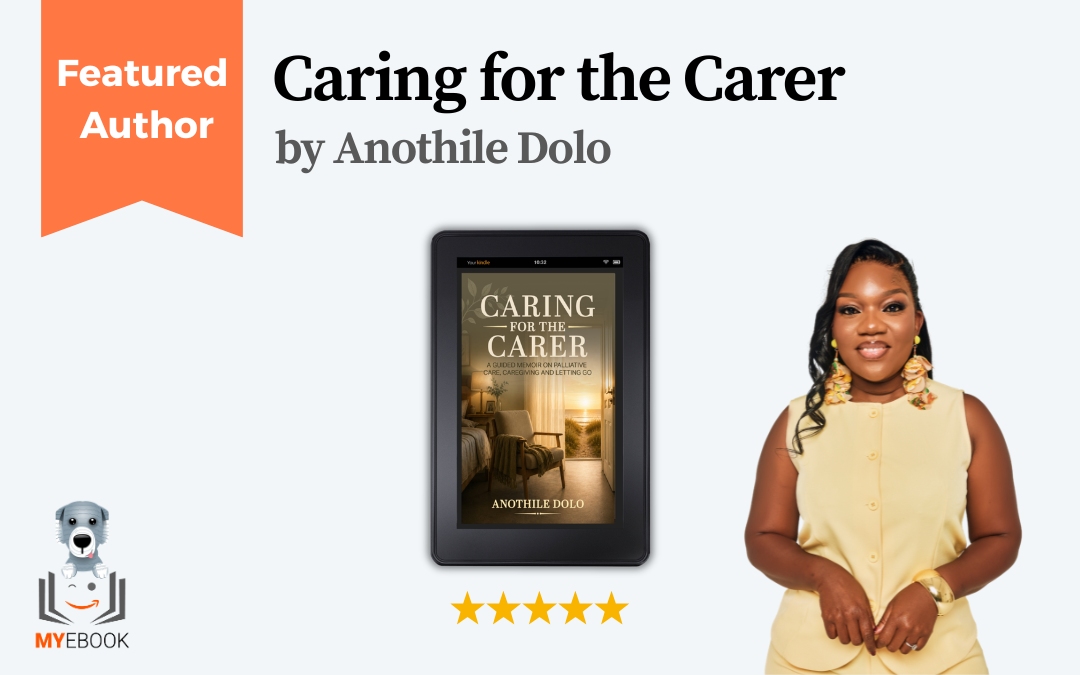
Anothile Dolo
Your book title
Caring for the Carer, A guided Memoir on palliative care, caregiving and letting go
If you had to pitch your book in a single sentence, what would you say?
Caring for the Carer is a guide to supporting the people who give everything to care for someone they love, told through the story of a daughter who lived it
What makes your book different?
Unlike most books on palliative care, this one follows the caregiver rather than the patient — written by someone who was both a clinician and a daughter at the same time, and who survived to tell both sides of the story
Who is your ideal reader, and what do you hope they get from reading your book?
My ideal reader is anyone who is caring for someone they love and wondering if they are doing enough, and what I hope they take away is the knowledge that they are not alone, and that the imperfect, exhausting care they are giving is both profound and enough.
What is your full-time profession?
Occupational Therapist
YOUR WRITING PROCESS
What inspired you to begin writing this book?
I wrote this book because the one I needed didn’t exist…I lived an experience that many people face but nobody talks about honestly, and I had both the professional language and the personal scars to tell that story
How long did it take you to complete your book’s final draft?
The seed was planted in 2018 when a close friend, who had been listening to me talk about my experience of caring for uMa, told me that my perspective was worth sharing more widely. She heard something in the way I spoke about caregiving — the dual lens of clinician and daughter — that she felt others needed to hear. That conversation stayed with me. Over the years that followed I did what most first-time authors do before they admit they are writing a book — I documented quietly. Paragraphs here, ideas there, fragments of memory and reflection that had nowhere to go yet. It was less like writing and more like gathering. When I finally made the decision to put it all together, it took approximately three months to complete the first full draft. Three months to shape seven years of living, grieving, documenting, and processing into something that could sit between two covers and be handed to a stranger. In some ways the book took three months to write. In other ways it took a lifetime
What were some of the biggest challenges you faced in writing your book, and how did you overcome them?
The biggest challenge was deciding how much detail to include — medically, emotionally, and relationally — and the answer every time was to ask: does this serve the reader, or does this only serve me
How did you approach the editing and proofreading stages of your book?
I approached editing as a collaboration between my lived experience, my professional knowledge, and a professional editor who was willing to ask the questions a reader would ask before the reader ever got the chance
What surprised you most about the writing or publishing process for this book?
Four things, honestly.
- How collaborative the editing process was. I expected correction, I got conversation.
- That my culture was honoured. Sheena preserved uMa exactly as it should be written, researched the isiZulu convention herself. That meant a lot.
- How graciously everyone named in the book responded when I sought their consent. I prepared for hesitation. I received warmth.
- And that the book was not too short. That had been my biggest anxiety.
YOUR SELF-PUBLISHING JOURNEY
What made you decide to opt for the self-publishing route for your book?
I had a story to tell and I did not want to wait for anyone to decide it was worth telling and on what terms.
Could you share a key learning experience from the self-publishing process?
Self-publishing is not the easier route. I can’t express that enough.
I assumed that bypassing traditional publishing would simplify things. What I discovered is that it does not remove the work, it just transfers it entirely to you. Every decision becomes yours. Editing, cover design, pricing, distribution, marketing. All of it.
It rewards involvement. And it requires far more of it than I anticipated.
What resources or tools did you find most valuable during your self-publishing journey?
Two things stood out above everything else.
The first was my professional editor, Sheena Carnie. Sheena’s contribution to this book cannot be overstated. She asked the questions a reader would ask, challenged language that was too clinical, and pushed me consistently back toward my own voice. Without that process the book would have been competent. With it, it became honest.
The second was my publisher Dave from MYeBook. Beyond the practical guidance around print configuration, pricing, and distribution, the Author Coaching Session gave me so much clarity I did not know I needed about my ideal reader, my brand, and what this book was actually for. That conversation shaped not just the publishing process but the business I am building around it.
Good people, it turns out, are the most valuable resource of all.
For your next book, what would you do differently when it comes to the writing / publishing process?
Honestly, I don’t even know if there will be a next book, but if there is, I would take my time
MARKETING AND BOOK PROMOTION
Have you written any other books?
No
How are you planning to connect with and find new readers?
On several fronts simultaneously.
A formal book launch event is planned, which will be the first opportunity to put the book directly into the hands of the people it was written for.
From there, I will be building my presence across social media platforms, as well as through my website anocares.com, which will serve as the home base for both the book and the broader Ano Cares brand.
I am also planning to reach out directly to hospices, palliative care organisations, and private caregiver support groups, spaces where the people who need this book already gather. Getting it into those environments feels more important to me than any algorithm.
Corporate wellness talks will be another avenue grief and caregiving in the workplace is widely underserved, and the book opens that conversation naturally.
And finally, community. A private online support community for caregivers is part of the vision because readers who feel held tend to become the most genuine advocates for a book.
What advice would you give to other self-published authors struggling to promote their book/s?
Choose the right publishing company!
Self-publishing does not mean doing it alone. The partner you choose will shape not just how your book looks and feels, but how you are supported through every stage of the process from manuscript to market. A good publishing partner brings expertise, guidance, and connections you do not yet have.
Do your research. Ask questions. Find someone who understands not just the technical side of publishing but the vision behind your book.
The right partner makes the difference between a book that exists and a book that reaches people.
LOOKING AHEAD
Do you have any upcoming books or projects you can share with us?
What is on the horizon is Ano Cares. A caregiver support platform built around the heart of this book. It will include individual and group support sessions, corporate wellness talks, healthcare team workshops, palliative care family coaching, and an evidence-based resource library for caregivers navigating terminal illness and loss.
The book was the beginning. The building of Ano Cares is what comes next.
Where can our readers find out more about you and your book?
The best place to start is my website anocares.com where you will find more about the book, my work as a caregiver support practitioner, and the Ano Cares platform.
You can also find me on social media, where I share resources, insights, and conversations around caregiving, palliative care, and loss.(LinkedIn.)
And if you are a hospice, healthcare organisation, or corporate looking to bring these conversations into your space, I would love to hear from you.
ADDITIONAL QUESTIONS
Is this book only for people dealing with terminal illness?
Not at all. While the book is rooted in a palliative care journey, its themes of caregiving, grief, guilt, love, identity under pressure, speak to anyone who has ever cared for someone they love through any serious illness or loss.
How did writing this book affect you personally?
It was healing in ways I did not anticipate. Putting the experience into words forced me to sit with things I had been carrying quietly for years. It gave shape to grief that had never fully been named. And it reminded me that uMa’s story, our story, was worth telling.
What do you hope the healthcare sector takes from this book?
That the caregiver is not a bystander, they are part of the unit of care. Asking a caregiver how they are coping is not a courtesy. It is a clinical intervention. I hope this book gives healthcare professionals a window into what families experience between hospital visits, the invisible labour, the quiet grief, and the profound need to be seen.
Why did you call it Caring for the Carer?
Because the carer is almost always the last person anyone thinks to care for. The title is both a description and a quiet challenge to readers, to healthcare professionals, and to anyone who has a caregiver in their life. Are you caring for them too?


